
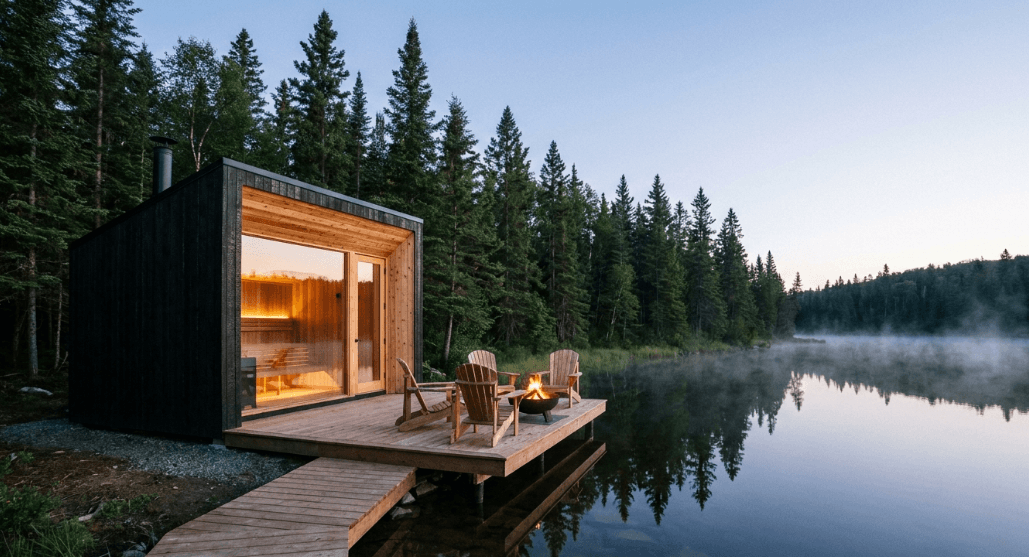
How to Pair an Outdoor Sauna With a Cold Plunge for Contrast Therapy
Contrast therapy alternates heat and cold to produce a strong circulatory response: roughly 10 to 15 minutes in an outdoor sauna at 170 to 190 degrees, followed by 1 to 3 minutes in cold water between 45 and 60 degrees, repeated for two to three rounds. The heat dilates blood vessels near the skin while the cold constricts them sharply, and cycling between the two is associated with short-term improvements in circulation and how recovered people report feeling, based on cohort and short-term physiological studies rather than controlled outcome trials in most people. Beginners should start with one round and shorter cold exposure before building up.
What Actually Happens to the Body During the Hot-Cold Cycle?
Heat exposure raises core and skin temperature, which widens blood vessels near the surface and increases heart rate as the body works to shed heat, similar to a moderate cardiovascular workout. Stepping into cold water reverses this almost immediately: vessels near the skin constrict, heart rate and blood pressure spike briefly, and blood is redirected toward the body’s core. Repeating this cycle several times is sometimes described as a vascular workout, since the vessels are being asked to dilate and constrict repeatedly in a short window. A short-term study of Finnish sauna users found measurable changes in blood-based markers of cardiovascular function following a single sauna session, which supports the idea that the hot side of the cycle alone produces a real physiological response worth taking seriously, not just a subjective feeling of relaxation.
How Should a Beginner Structure the First Few Sessions?
Start with a single round: 10 minutes in the sauna, then 60 to 90 seconds in cold water, followed by a normal cooldown at room temperature. If that feels manageable after a few sessions, extend to two rounds, then eventually three, rather than jumping straight to a longer protocol. Cold exposure should always be timed, not judged by feel, since the temptation to push past the point of comfort increases as the body adapts and comfort with cold is not the same as physiological safety. Ending on cold is common for people who want the alerting, energizing effect afterward, while ending on a brief warm-up suits people using the routine before bed. Neither order is objectively correct; it depends on when the session happens and what the person wants afterward.
What Temperature and Duration Actually Work for the Cold Side?
A functional home cold plunge for contrast therapy usually runs 45 to 60 degrees Fahrenheit, cold enough to trigger a strong response without requiring ice or near-freezing water that raises the risk of an uncontrolled gasp reflex in open water. Immersion to at least chest depth for 1 to 3 minutes is a common target; briefer dips under 30 seconds mostly produce a psychological jolt rather than the sustained vasoconstriction that defines the contrast effect. Chiller-equipped tubs hold a set temperature automatically, while an unchilled tub filled with hose water and ice packs will drift several degrees warmer over a session, which is worth accounting for when timing the cold side of the protocol.
Does Cold Exposure Interfere With Training Adaptations?
This is the honest caveat in an otherwise favorable picture: evidence on cold-water immersion for recovery is mixed, and some resistance-training research suggests that cold exposure done soon after lifting may blunt the strength and hypertrophy gains that training is meant to produce. A 2025 systematic review and meta-analysis on cold-water immersion and general health outcomes, one of the more current syntheses on the topic, underscores that the picture is mixed rather than uniformly positive. People training primarily for endurance or general recovery appear less likely to be affected than people specifically training for muscle growth. A practical workaround is separating the two activities by several hours, doing contrast therapy in the evening and strength training earlier in the day, rather than stacking cold immersion directly onto a lifting session.
What Setup Does a Home Contrast Therapy Routine Actually Require?
On the hot side, an outdoor sauna with a heater sized to reach 170 to 190 degrees within 30 to 40 minutes is standard; on the cold side, options range from a simple insulated stock tank with bagged ice up to a dedicated chiller unit that holds a fixed temperature without manual refilling. Placing the two units within a short walk of each other matters more for a contrast routine than for sauna use alone, since body temperature starts dropping the moment someone steps outside between rounds, and a long walk in winter air undercuts the deliberate, controlled nature of the temperature swing. Retailers that carry both outdoor sauna and cold plunge equipment, including SweatDecks, list heater and chiller specifications side by side, which makes it easier to size a matched pair rather than buying each piece from a different source with inconsistent specs.
What Does the Cardiovascular Research Actually Support?
The strongest evidence base here is on the sauna side. A large Finnish cohort study published in JAMA Internal Medicine found that men who used a sauna four to seven times a week had lower rates of fatal cardiovascular events and all-cause mortality than men who used one once a week, an association that held after adjusting for other risk factors. A follow-up study in Annals of Medicine found that sauna use combined with higher cardiorespiratory fitness was jointly associated with lower cardiovascular and all-cause mortality risk. A separate study in Heart and Vessels measured short-term changes in blood-based cardiovascular markers after sauna sessions in regular users. None of these studies were designed around the cold-plunge side of contrast therapy specifically, so the combined-protocol evidence is thinner than the sauna-alone evidence, and it is fair to describe contrast therapy as physiologically plausible and popular among regular practitioners rather than as a proven intervention with its own dedicated outcome trials.
Frequently Asked Questions
How many rounds of hot and cold should a beginner do? Two to three rounds is reasonable: roughly 10 to 15 minutes in the sauna followed by 1 to 3 minutes in cold water, always starting with fewer rounds and building up.
How cold does the plunge need to be? Most home setups run 45 to 60 degrees Fahrenheit, enough to trigger a strong response without needing near-freezing water.
Should contrast therapy be done right after strength training? Some research suggests cold-water immersion soon after resistance training may blunt strength and hypertrophy adaptations, so separating the two by several hours is a reasonable option.
Who should be cautious about combining sauna and cold plunge? Anyone with unstable cardiovascular disease, uncontrolled high blood pressure, a recent cardiac event, or who is pregnant should approach the temperature swing conservatively.
References
- Association between sauna bathing and fatal cardiovascular and all-cause mortality events, JAMA Internal Medicine, 2015
- Joint associations of sauna bathing and cardiorespiratory fitness on cardiovascular and all-cause mortality risk, Annals of Medicine, 2018
- Short-term effects of Finnish sauna bathing on blood-based markers of cardiovascular function in non-naive sauna users, Heart and Vessels, 2018
- Effects of cold-water immersion on health and wellbeing: A systematic review and meta-analysis, PLoS One, 2025